Showing posts with label cucumber. Show all posts

October 15, 2013

Japanese Pickled Ginger and Sushi at Home. Sort of...

Like many, one of my favorite meals out is sushi.  I have made (vegetarian) sushi at home, too, which is a lot of fun, but also an event.


When I'm wanting the flavor of sushi without the cost of going out or all the work, I make "Sushi Salad."  It satisfies my craving and is fairly easy to make.  It does call for a few specialty ingredients, like the pickled ginger that is a standard at sushi bars, which I tried making at home recently with very good results.


If you have a mandoline (I'm absolutely loving my new one!), Japanese Pickled Ginger is quite simple. Slicing the ginger paper thin is definitely the most difficult and time-consuming part, but it's certainly worth the effort.

I bought about a pound of ginger a few weeks ago at the Asian market with the intention of making the condiment, and I was lucky enough to find very fresh, young ginger at a good price.  I made a double recipe, which is a couple pints, and the ginger will keep for months in the refrigerator.


So, basically, I have a lot of home sushi projects to complete in the coming year.  For now, I will settle for my simple sushi salad.  The flavor and texture of the pickled ginger is so nice, though, and I may dream up other ways to use it.  At the very least, it make for a great pick-me-up and cook's snack while other ingredients are being prepped.


JAPANESE PICKLED GINGER
(adapted from The Joy of Pickling, by Linda Zeidrich)
  • 8 oz. fresh, peeled ginger, very thinly sliced
  • 1 t. sea salt (or pickling salt), plus more for sprinkling
  • 1 cup rice vinegar (not seasoned)
  • 3 T. sugar
  • 1 t. soy sauce

Bring a saucepan with about a quart of water to a boil.   Add ginger and return to boil.  Boil ginger for a few seconds and drain well in a colander.  Place ginger in a bowl and sprinkle very lightly with salt.  Toss to coat and pack into one pint or two half-pint jars.  These are quick fridge pickles and a loose pack will be fine.

In a medium saucepan, bring vinegar, one teaspoon salt, sugar, and soy sauce to a simmer.  Stir to dissolve the salt and sugar.  Pour hot mixture over ginger and cap the jars.  Store them in the refrigerator for at least two days before using. Ginger will keep for several months.

Of course, you can also find pickled ginger at an Asian grocery, but it will likely have MSG and pink food dye.  I won't judge you.


SUSHI SALAD
  • 1 1/2 cup rice - I like brown rice in this application
  • 1/4 cup plus 3 T. rice vinegar (again, unseasoned)
  • 3 T. sugar
  • 1 1/2 t. salt
  • 2 T. sesame seeds (I like the black ones for this, but I'm out of them at the moment)
  • 3 T. vegetable oil
  • 2 T. Japanese Pickled Ginger, minced
  • 1/2 cup carrots, julienned (or fine dice)
  • 1 cucumber, seeded and julienned (or fine dice)
  • 1 avocado, sliced thin
  • 2 t. wasabi powder
  • 3 T. water
  • 2 T. soy sauce
  • 1 T. ginger pickling brine
  • 1-2 sheets nori

Cook rice according to type and transfer to a large bowl and set aside to cool.  Meanwhile, heat 1/4 cup vinegar, sugar, and salt in a small saucepan and stir until sugar and salt is dissolved.  Stir into cooked rice along with sesame seeds.  Stir in three tablespoons vinegar, oil, ginger, carrots, and cucumber.  Set aside.

In a small bowl or measuring cup, combine wasabi powder, water, soy sauce, and pickling brine. Set aside.

In serving bowl, place rice mixture and top with avocado.  Drizzle with wasabi mixture and strips of nori.  With the nori, I like to cut a sheet in thirds with kitchen shears, roll lengthwise, and cut crosswise with the shears over the salad.  Enjoy!

October 7, 2013

Pad Thai at Home...with Bacon!

I've heard that orders for Pad Thai in Thai restaurants outpaces every other dish on the menu by a landslide. In me, this triggers the response of ordering something different when I go out for Thai (and I highly suggest the Pad See Ew at Thai Monkey Club in Denver) .  But I do love Pad Thai.


There are a couple of issues with making my favorite recipe for Pad Thai at home, however.  Namely, it calls for shrimp and that means I'd have to make a special trip to the store and spend more than I'm willing for sustainable seafood on a weeknight.  Same with the tamarind puree.  And just where does one find "sweet" radishes?  But since I am still reaping the benefits of my shopping trip to H-Mart, I do have plenty of rice noodles and at the time, I had lots of shiitakes.


A couple of impulse buys and substitutions later, and Bacon Pad Thai is on.  At home.  So I traded brown sugar for palm sugar, ketchup for tamarind puree, cucumber for sweet radish, and a lovely combo of bacon and shiitakes for shrimp.  I think that's enough to call a recipe my own, don't you?


Also, this is a good recipe for mise en place, as there is some knife work and a few different parts that come together quickly. Consciously shifting the time spent on cooking to prep work allowed me to focus on neatly chopped and julienned vegetables. Aren't they pretty?


And then it really is a snap to put together. I did have a head start because I had purchased bacon as a reward for completing the food sensitivity thing and had pre-cooked half the package for another meal. Okay, just BLTs my way, which will hopefully be another post soon.


Also, mise en place cooking results in many photos, in my case.  I hope you are inspired to try out the recipe and make your own substitutions to make it work for you. For example, you could sub extra tofu and mushrooms for bacon and watered-down soy sauce for the fish sauce if you're a vegetarian. Or if you do keep shrimp stocked at home, you can go back to the standard.  So, settle in for some knife skills practice and enjoy your restaurant meal at home.


BACON PAD THAI

  • 8 oz. rice noodles (medium width)

  • 2 T. brown sugar
  • 1 T. ketchup
  • 2 T. fish sauce
  • 1 T. lime juice
  • 2 T. white vinegar
  • 1 t. paprika
  • 1/2 t. cayenne, or to taste
  • 1 t. salt

  • 3 T. vegetable oil
  • 2-3 cloves garlic, minced
  • 1 T. onion, minced
  • 2 T. cucumber, seeded and minced
  • 2 T. carrot, julienned (optional)
  • 1/4 cup tofu, julienned
  • 3-4 strips cooked bacon, chopped finely
  • 2 eggs, beaten

  • 1/4 cup water
  • 1 cup mung bean sprouts (optional)
  • 1/4 cup chopped peanuts, plus more to garnish
  • lime wedges, to garnish
  • chopped cilantro, to garnish (optional)

Soak noodles in a bowl of warm water for 15 minutes, as you begin to prep the rest of the ingredients. Then drain and set aside.

In a small bowl, stir together the brown sugar, ketchup, fish sauce, lime juice, vinegar, paprika, cayenne, and salt. Set aside.  This might be a good time to beat the eggs in another small bowl and set aside, as well.

Heat oil in a large (non-stick) skillet over medium-high heat.  Add garlic, onion, cucumber, carrot, tofu, and bacon. Toss gently in the oil and cook until vegetables soften.  It will smell really, really good.  Push vegetables to the side of the pan and allow the oil to re-coat the pan.  Pour in beaten eggs.  As the eggs set, push in edges with a spatula and continue until eggs are cooked through and separated into pieces.

Mix everything back together and add the softened noodles.  Pour in the water and reduce the heat to medium. Allow the steam to cook the noodles for two or three minutes.  Then add the sauce and sprouts and stir to coat. Continue to cook for about five minutes, allowing the noodles to absorb the sauce and the pan to become almost dry.

Place into serving bowls and top with peanuts, lime, and cilantro.  Enjoy!

September 9, 2013

Garden Series, Part VIII: Carrots and Cucumbers

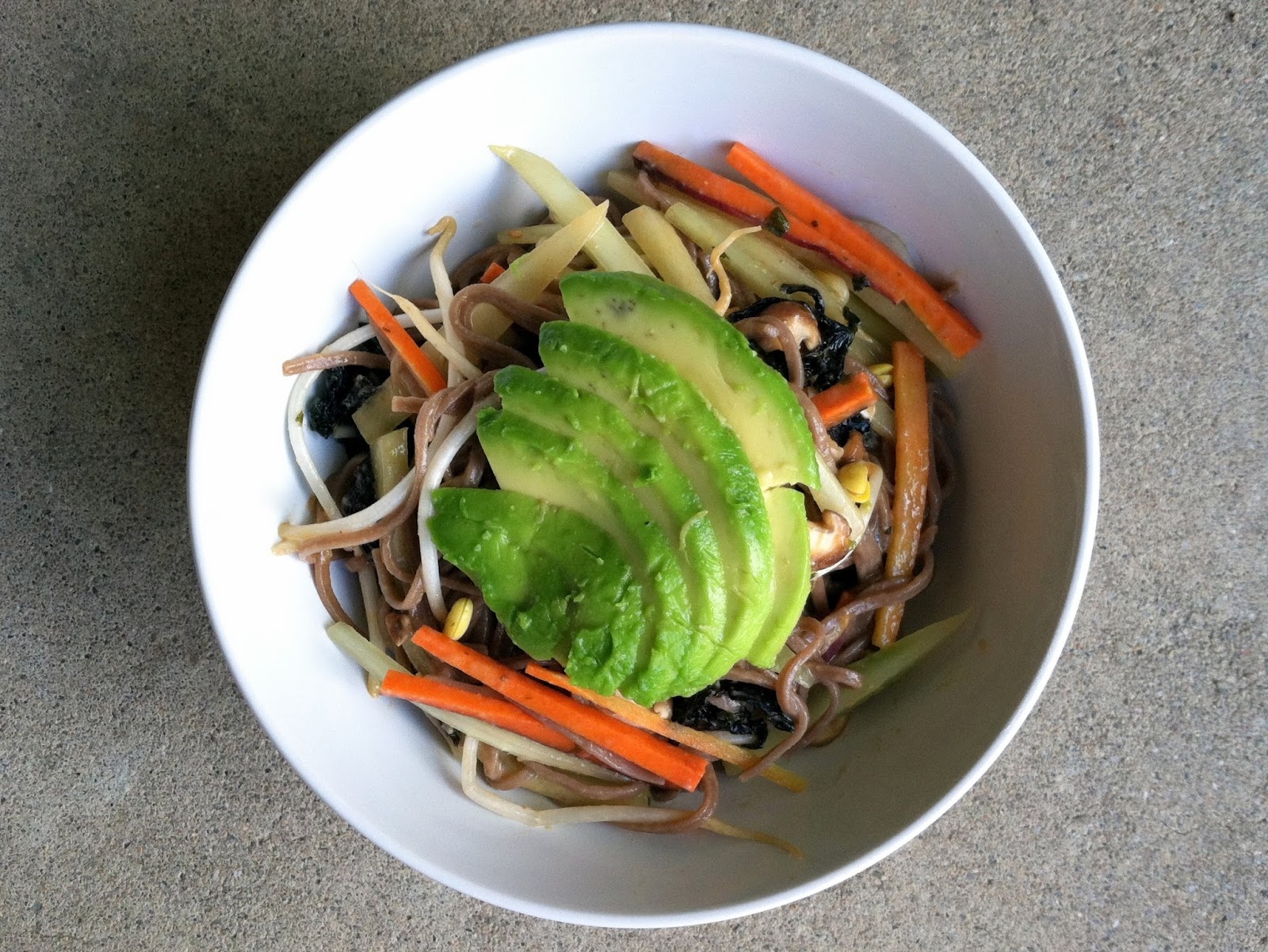
Recently, I was in the middle of a baking project and realized I had missed lunch.  Also recently, I went on an excursion to H-Mart in the suburbs with a dear friend of mine and loaded up on ingredients not found in the local grocery.  Such a good match, these two occurrences.  Throw in some garden produce, and you've got a late lunch. Or dinner, I'm not picky.


But not to worry, I'm not giving you a recipe with a bunch of hard-to-find ingredients.  In fact, it relies on the American standard of the sweetest, most-hydrogenated peanut butter, which I love despite all its failures.  Of course, you are welcome to use the natural stuff, if you have that sort of thing lying around.

Besides the Jiffy, the most exotic ingredients are soba noodles, Sriracha, and shiitake mushrooms - all of which one can find in the regular grocery store, but probably for twice the cost.  I'm not sure about the Sriracha, though, since I bought a huge bottle of it the last time I went to H-Mart and have never looked back.  It's basically an essential pantry ingredient.


In the pictures, you'll see a pile of fried seaweed with sesame seeds.  This stuff is seriously delicious, but probably far less likely to be found anywhere but the giant Asian grocery in the suburbs.  It turns out that it's best eaten as a snack on the side anyway.  I have no idea what's in it it either, but I'm pretty sure that it's manufactured to have an addictive balance of salt, sugar, and fat that makes it so you can't stop eating it.  You'll never know whether I'm snacking on it right now while I'm writing this.


As for the carrots and cucumbers, I highly recommend getting your hands on homegrown.  I know this isn't necessarily that easy, but homegrown carrots are the best.  They taste really, really good and if you eat conventional baby carrots from the supermarket, you will be really surprised at the carrot-y taste of back yard carrots.  I grow a variety of them because I am still fascinated by purple (Cosmic) and red (Atomic) carrots after my fifth garden.  I grow a few different cucumbers, but my long-standing favorite is Suyo Long.  It's a strange-looking variety that stays crisp, has few seeds, and refreshing cucumber flavor.


SOBA NOODLES WITH VEGETABLES

  • 1 bundle (serving) soba noodles
  • 2-4 shiitake mushrooms, sliced
  • 1/2 cucumber, seeded and cut into matchsticks
  • 1 carrot, cut into matchsticks
  • large handful mung bean sprouts, picked over and rinsed
  • radishes, or any other vegetable that sounds good (optional), cut into matchsticks/julienned
  • 1/4 avocado, sliced
  • olive oil
  • pinch salt
  • 2 t. peanut butter
  • 2 t. soy sauce
  • Sriracha, to taste

Cook soba noodles according to package directions.  Rinse well under cold, running water and allow to drain.

Heat a scant tablespoon olive oil in skillet over medium heat.  Add shiitakes and stir to coat with oil. Stir in salt and sauté until thoroughly cooked.  Set aside to cool.

In a small bowl, combine peanut butter, soy sauce, and Sriracha.  In individual serving bowl, toss together noodles, shiitakes, cucumbers, carrots, sprouts, and sauce.  Top with avocado.  Feel free to add more soy sauce and/or Sriracha to season to taste.

Serves one. 


*Later in the week I made a crazy delicious Bacon Pad Thai.  I took no pictures of it, but perhaps round two will surface in a week or two.

August 19, 2013

The Plan, or "Dieting"

I will be the first to tell you, I don't diet.


I'm of healthy weight and like to eat.  General concepts like "everything in moderation" and "eat food, not too much, mostly plants" work better for me than psyllium husks; non-fat, food-like products; and fake sugar.  I find the forced limitations of dieting to be damaging in more ways than beneficial.  Not to mention that the latest new thing will be negated in a few days or years and replaced by the next, with equal and exhausting enthusiasm.


On the other hand, I'm not too fond of my poor complexion or dry eyes or other discomforts that bother me from time to time.  And I have allowed myself to be convinced that if I find which foods might be causing these reactions in my body, I might just be able to clear them up.  How great would that be?

Well, perhaps not so great if it is determined that I react negatively to foods I love.  Like any member of the nightshade family or mushrooms or dairy.  Or wheat.  But, I already do not eat the foods I dislike, so I suppose that the culprits must be ones I enjoy.

Taking in all the factors, I have decided to complete a three-week regimen that is something like a modified elimination diet.  I repeat, I am not interested in losing weight.  I want to reiterate this fact, because I do not have a weight problem and have shocked at least four (well-rounded, intelligent, open-minded) people by stating that I do not have an innate "female" desire to be über-thin and consequentially well-liked by all.  I simply want to be healthy and feel good.


Luckily, the food I am eating throughout the regimen is satisfying.  Whole and low-reactive foods can still be delicious and, well, pretty!  Making my meals look good makes a huge difference when I'm missing lattes and pastries.  Or any of the celebratory LaMar Donuts that my coworkers brought into work last week (they're so good!).  It also helps that if I feel fine after eating wheat and dairy products this week, lattes and pastries are in my near future.  Woo-hoo!

It is somehow comforting that I did not feel fine after eating copious amounts of flax seeds last week.  Ugh.  I am supposed to start my day with a bowlful of "flax granola" (above), which is a morning routine I quickly came to dread...even the prettiness of it couldn't save that one for me.  Then I realized that me practically gagging on the stuff was some sort of a negative reaction and that I should probably eliminate this "fabulous" health food.  Since cutting this part out and replacing it with tasty things, like fruit and Silk Coconut milk, I feel so much better emotionally about breakfast that I feel better physically, too.  Yay!  First "diet" lesson learned.


Everything else has been satisfying and fulfilling.  It feels wonderful to have eaten 99% whole foods for several days, but to also feel full and eat good-tasting meals. It's nice to discover that recipes that sound boring, like julienned carrots and a shredded raw beet (above, with a candy stripe beet from my garden), are actually really great.

I'm learning to put together common-sense, balanced meals and am looking forward to the end of the trial period, when I can start developing my own recipes that are based on a solid, balanced theory of eating.  I think it will lead to some brand-new, delicious recipes for Omnivora!

Most importantly, figuring out what doesn't really work for me doesn't mean that anything is out of my life forever.  I can learn how to manage problematic foods in a way that allows me to enjoy them if I love them.  And that is what eating well is all about, right?


MANGO CUCUMBER SALSA
Adapted from The Plan, by Lyn-Genet Recitas*
  • 1 mango, small dice
  • 1 pickling or English cucumber, small dice
  • juice of 1 lime
  • 1 jalapeño
  • sea salt
  • 1/4 cup cilantro, chopped (optional)

If you have a gas range (and I hope you do!), roast jalapeño over open flame, until well-blistered.  Set aside to cool.

Combine mango, cucumber, and lime juice in a bowl.  Mince jalapeño and stir into salsa, along with cilantro, if using.  Salt to taste and serve with anything you can think of...like fish or other meat, or tortilla chips, or broiled tofu.  It's delicious and you will love it.  I will be making it for an upcoming salsa party.


*The dietary plan I am following is The Plan, by Lyn-Genet Recitas.  I really am having a great time with it and I hope to learn about the foods I don't handle well.  The book is an interesting read, but could use a cookbook editor - planning for The Plan can get out of control.  The website offers shopping lists and alternate menu plans, based on previously held dietary restrictions.  It definitely helps if you like to make spreadsheets and are generally analytical like I am.